Most people call about a limb after it has already come down. The ones worth calling about are the ones still up there, and there are usually a few clear signs telling you which is which. Here is what we look at.
1. The four signs a limb is already dead
A dead limb doesn't fall on a schedule. It falls when the wind, the ice, or its own weight finally decides. Look for these in summer, when a live tree makes the dead parts obvious:
- No leaves in July. The simplest test there is. If everything around it has leafed out and one limb hasn't, that limb is done.
- Bark coming off in sheets. Live limbs hold their bark tight. Bare grey wood showing through means it has been dead a while.
- Small branches snap instead of bend. Take a twig off the end. Green and flexible is alive. Dry and brittle with no green under the surface is not.
- Fungus growing out of the limb itself. Shelf fungus means the inside is already rotting.
One dead limb in the middle of an otherwise healthy tree is normal and not an emergency. Trees shed their lower limbs as they grow. What matters is what sits underneath it.
2. What's underneath decides how urgent it is
This is the part people get backwards. The question isn't really how bad the limb looks. It's what it lands on.
A roof, a driveway where cars park, a deck or patio you actually sit on, a fence line, a shed, a play set, or anywhere the kids and the dog go.
A dead limb hanging over the back corner of a wooded lot can wait until you're having other work done. The same limb over the garage is a different conversation, because a limb heavy enough to matter is heavy enough to go through roof sheathing.
3. Live limbs that are still a problem
Not everything worth taking down is dead. The ones we get called about most:
- Limbs rubbing the roof or siding. Every windy day they sand the shingles a little more, and they hand squirrels a bridge straight onto your roof.
- Low limbs over the drive. Usually fine right up until a delivery truck finds them.
- Limbs growing into the power drop. Anything actually touching a wire is a job for the utility. Not for us, and not for you.
- Heavy horizontal limbs with a split at the collar. A visible crack where the limb meets the trunk means it is already failing.
- Anything keeping a roof or a fence permanently damp. Constant shade and wet is what shortens the life of both.
4. Why western PA is hard on trees
Our weather does a particular kind of damage. Ice storms load limbs with several times their own weight, and the ones that break are almost always the limbs that were already dead or cracked before winter started. Then freeze and thaw works those cracks a little wider every year.
Silver maples are all over this area, grow fast, and have weak wood that splits at tight forks. If you have a big one close to the house, it's worth looking it over every couple of years rather than letting a storm sort it out for you.
Ash trees are their own story. Emerald ash borer has killed most of the ash in this part of Pennsylvania, and a dead ash goes brittle unusually fast. A standing dead ash near a building is the one not to leave another season.
5. What you can do yourself, and what you shouldn't
Plenty of small limb work is a fine Saturday job. Anything you can reach with both feet on the ground and cut with a hand saw or a pole pruner, go ahead.
Where it goes wrong is the middle ground. A ladder, a chainsaw and a limb over your head is how people get hurt, because you can't control where the limb goes and you have no free hand when it moves. If the cut is above head height, or the limb is over something that matters, that's the point to stop.
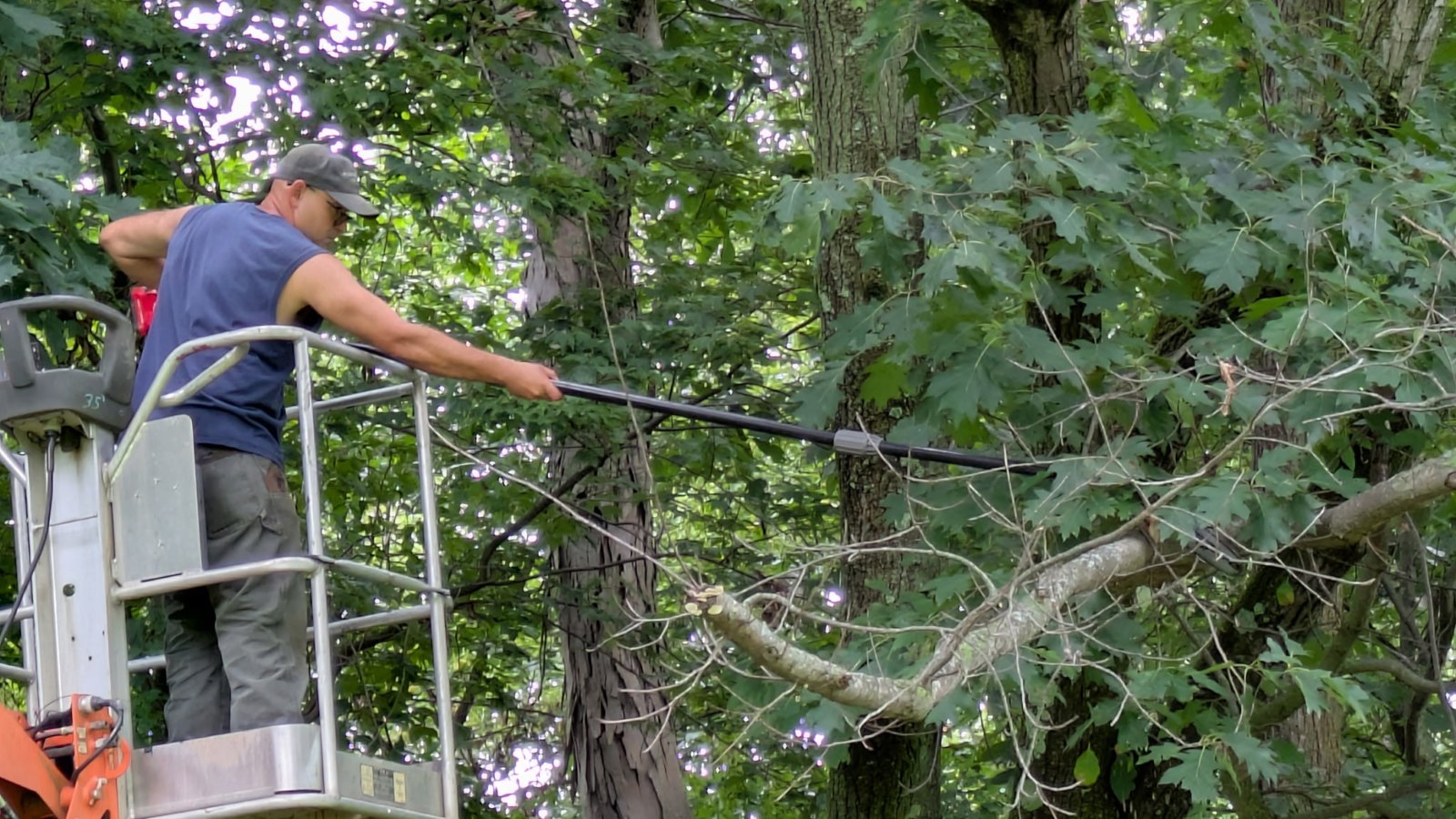
We work off a 35ft lift rather than a ladder, and we take a big limb down in sections instead of one cut. It's slower, and it's the reason nothing lands where it shouldn't.
6. Where our work stops
We do small tree work. Limbs, deadwood, brush and small trees. That's the honest limit, and it covers most of what homeowners actually call about.
What we don't do is take down a large mature tree, work on anything leaning on a power line, or handle a tree that has already come down on a structure. Those want a certified arborist with a crane and the insurance that goes with it. If that's what you have, we'll tell you straight away rather than have a go at it.
What it looks like when we come out
We'll take a look, tell you which limbs actually need doing and which ones you can leave, and give you a written price that doesn't move. Brush gets cut down, loaded and hauled off, and the ground raked back before we leave.
If you're having other work done anyway, limb work is worth putting on the same visit. It's the same trip either way, and it's usually the cheapest time to get it dealt with.
One picture from the ground showing the whole tree, and one closer up on the limb you're worried about. That's usually enough for us to tell you whether it needs doing now, can wait, or wants somebody with more equipment than we bring.